My second year as a professional groomer, I took in a Siberian Husky named “Koda” who was right in the middle of blowing his seasonal coat. Chunks of gray undercoat were falling off him like snow.
I thought I was doing the owner a massive favor. I reached for a heavy, ultra-hydrating, thick oatmeal shampoo to “moisturize and repair” his skin. I lathered him up, scrubbed hard, and rinsed.
When I put him on the table and turned on the high-velocity dryer, I almost started crying.
If you want to keep your dog’s skin healthy and your vacuum cleaner functional, you need to be using the Best Dog Shampoo for Huskies—which, as it turns out, isn’t actually a “Husky shampoo” at all. It is a system designed to release the undercoat.
Koda’s coat didn’t blow out. It had turned into concrete. The heavy waxes in that “moisturizing” shampoo acted like glue, binding the dead, shedding undercoat directly to his live guard hairs. I had instantly created a solid, wet pelt across his entire back. It took me four agonizing hours of meticulous brushing, re-washing with a clarifying shampoo, and drying to fix my mistake. Koda was exhausted, I was humiliated, and my hands were bleeding.
That nightmare forced me to study the thermodynamics of the Arctic double coat. I realized the profound mistake almost all pet owners make: You do not wash a Husky to clean them. You wash a Husky to manage their undercoat.
If your house is covered in tumbleweeds of fur, or your husky smells like a damp basement and is scratching constantly, stop buying generic “pet store” soap. Here is my Master Groomer framework for handling the Arctic double coat, the exact clinical-grade products I use in my salon, and the protocol to get the undercoat out without destroying their waterproofing.
Part 1: “Arctic Armor” Biology (Why Most Shampoos Suck)
Siberian Huskies, Malamutes, and Samoyeds have a very specific, two-level biological “armored” structure:
- The Guard Hair: the tough hairs that protect from the elements like snow, water, and dirt. They are covered with protective lipids (think Teflon).
- The Undercoat: the thick, warm, and soft underlayer that retains body heat and keeps the dog protected from cold.
What happens when you put just any high-sudsing detergent on a Husky? Two bad things:
First, you remove its natural lipids that protect from moisture. This makes hair brittle and susceptible to static electricity.
Second, when the shampoo is too concentrated (such as mine) and doesn’t rinse out properly, it stays inside the undercoat, where it begins to rot against the skin, causing nasty bacterial spots.
This shampoo needs to be light enough to break through the “armor,” yet powerful enough to loosen and release the dead undercoat.
Part 2: The Diagnostic Chart (Does Your Husky Actually Need a Bath?)
Before you turn on the water, you must diagnose the state of their skin and coat. 90% of the time, a Husky needs a high-velocity blow-dry, not a bath. Use this chart first.
| What You See/Smell | The Biological Phase / Root Cause | The Required Solution |
|---|---|---|
| “Massive shedding, tufts sticking out of hips.” | “Blowing Coat” (Seasonal shedding of the entire undercoat). | BATH. Use a shampoo with Amino Acids/Silk Proteins to lubricate the follicles for extraction. |
| Dried mud, sand, or dust; no bad odor. | Environmental debris resting on the guard hairs. | NO BATH. Wait for it to dry, then use a slicker brush and high-velocity dryer to blow the dirt out. |
| Dull, coarse topcoat, dry flakes on skin. | Winter/Dry Phase (Skin barrier lacks moisture). | BATH. Use a shampoo with Squalane or Omega Fatty Acids to rebuild the lipid layer. |
| Thick, crusty lesions around eyes/muzzle. | Zinc-Responsive Dermatosis (genetic condition). | VET VISIT. This requires dietary supplements and a medicated shampoo. |
| Musty “wet dog” smell, greasy roots. | Sebum buildup and compacted undercoat trapping yeast. | BATH. Use a Salicylic Acid or Citrus Degreaser to cut trapped oils. |
| Rolled in feces, skunk, or sour smell. | The lipid barrier has been breached by biological enzymes. | BATH (Emergency). Use an Enzymatic or Clarifying Shampoo. |
Part 3: The Professional Wash Protocol (Avoiding the ‘Koda Concrete’)
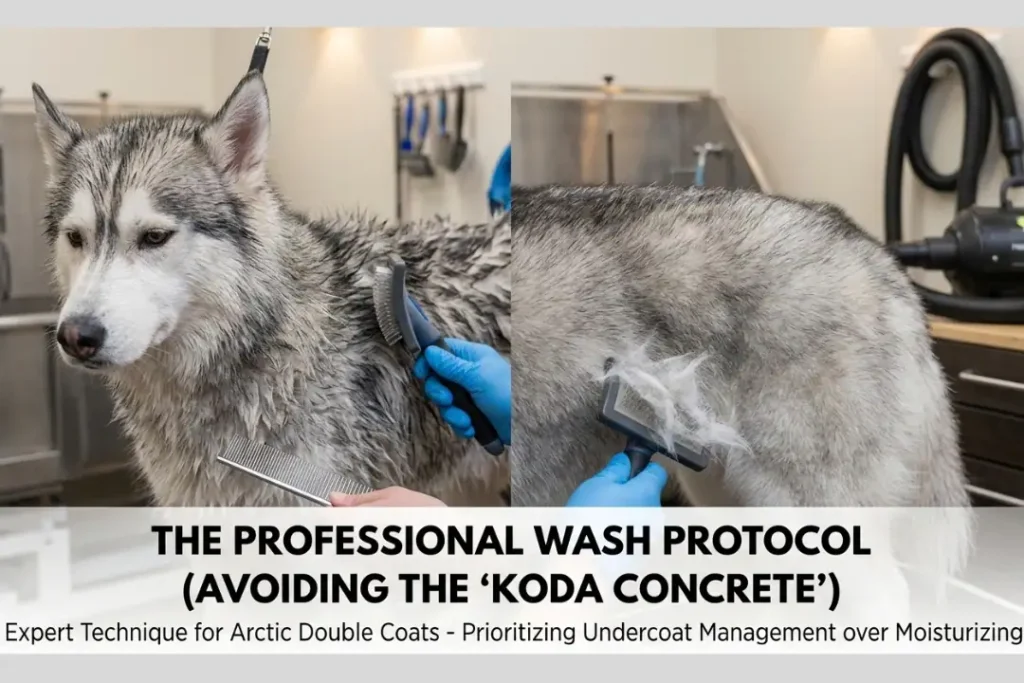
When a Husky is blowing their coat, a bath is the most effective way to remove the dead hairs. Scrubbing them after wetting them only leads to a matting disaster (trust me, I learned the hard way). Here is my 3-step tub method.
Dry Excavation (The 40% Rule) – Step 1 Never put a shedding Husky straight into the tub. This makes the dead undercoat swell and lock together.
My Hack: Before a drop of water is allowed to touch the dog, take them outside or into a garage and apply the high-velocity dryer to their entirely dry coat. The primary ‘tufts’ that are loose need to be blown out first. Shampooing doesn’t have to deal with 40% of dead hair.
Step 2: The Canopy Penetration Husky guard hairs repel water; however, if one only sprays them with a showerhead, the skin under them stays perfectly dry. To force warm water through the canopy, one has to use a high-pressure nozzle directly against the skin. Spraying a Husky continuously for five minutes is sometimes necessary to make it truly wet.
Step 3: The ‘Reverse-Conditioning’ Undercoat Release (The Koda Fixer) If your husky is actively blowing their coat, do not start with a shampoo. If you wet-compact the undercoat and apply soap first, it shrinks and tightens like a wool sweater in a hot dryer.
Professional Method: After soaking, do not use shampoo yet. Take a dog conditioner that is lightweight and water-soluble (Chris Christensen Ice on Ice is one such product) and massage it straight into the wet, shedding undercoat. Keep it on for 5 minutes.
Why this works: The conditioner functions as a slip agent. It lubricates dead hairs that are tangled in the live hairs. Take a wide-toothed grooming comb and comb gently through the soapy conditioner. You will be able to pull out dead undercoat sheets with zero friction. Rinse out the conditioner and then apply the de-shedding shampoo for cleaning the skin.
Part 4: The ‘Big Three’: My Best Dog Shampoo for Huskies-Vetted Salon Arsenal
I do not use standard moisturizing shampoos on northern breeds. I use structural and de-shedding formulas that are specifically designed to penetrate dense wool. These are three products that I stake my reputation on.
1. The Avalanche Inducer (Best for ‘Blowing Coat’) Best pick: iGroom Deshedding + Detangling Shampoo
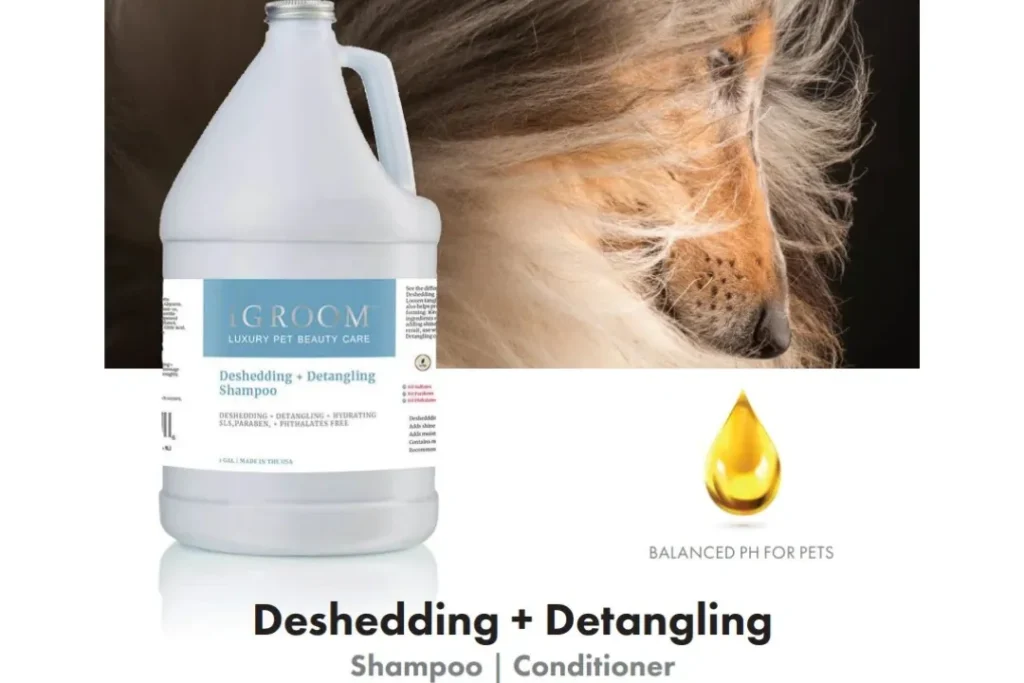
This is my absolute holy grail for a husky blowing its coat (The Chemistry). It is a proprietary blend of lightweight amino acids and keratin that penetrates deep in the hair follicle to loosen the grip skin has on the dead undercoat. Severe shedding in spring and fall.
My Experience: I pair this shampoo with the ‘reverse-conditioning’ hack above. My Experience: I use this shampoo in combination with the ‘Reverse-Conditioning’ hack I described above.” (CFL, n.d.) “When I rinse the dog, the dead undercoat literally flows down the drain in sheets. That cuts my brushing time in half.
2. The Degreasing Reset (For Skunk, Mud, and the ‘Sour’ Smell) Best Pick: Nature’s Specialties Plum Silky
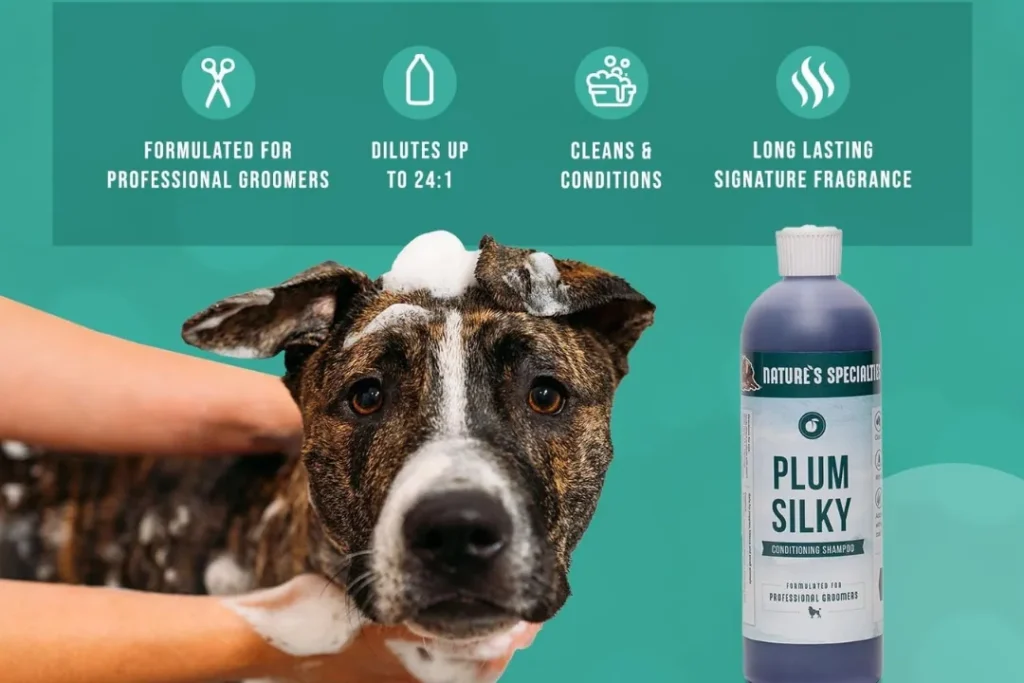
The Chemistry: Sometimes a Husky’s coat gets ‘packed’ with an overproduction of sebum (particularly in unneutered males or dogs with a poor diet). Plum Silky is a mild clarifying agent. It also retains a subtle light botanical scent at the end of the process. Best For: Huskies that smell sour, dogs that feel ‘sticky’ to the touch, or emergency de-skunking.
Warning: This should only be used as a ‘reset button.’ If you use it every month, you will be ruining their natural waterproofing.
3. The Structural Cleanser (Routine Maintenance) TropiClean PerfectFur Double Coat (Best for Routine Maintenance)
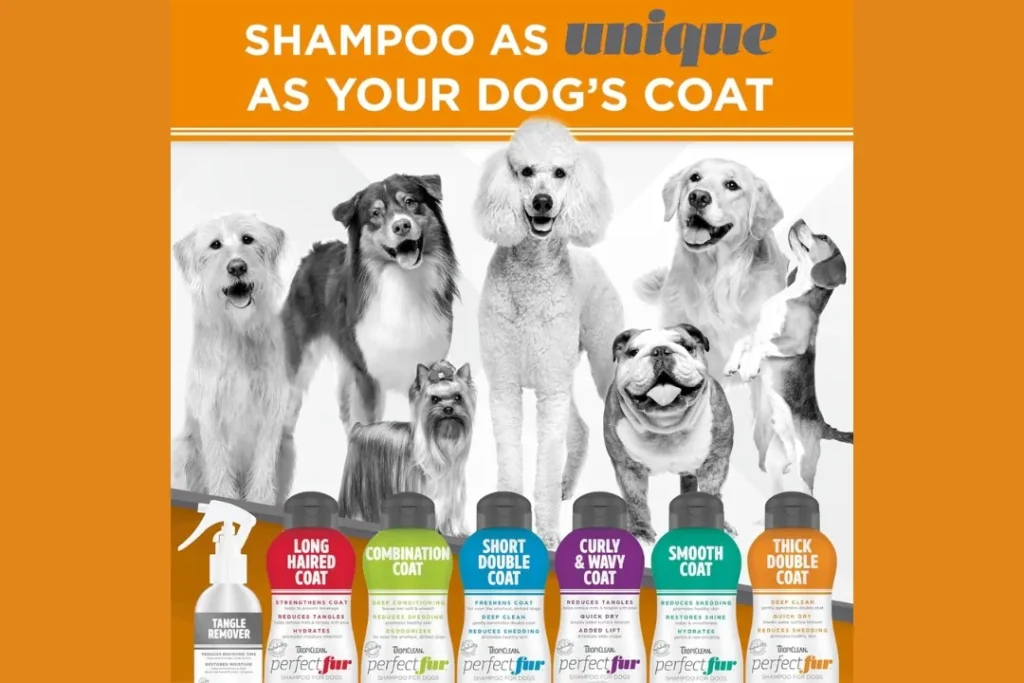
The Chemistry: Specifically made for double-coat breeds. It’s mild, naturally derived coconut cleansers strip surface dirt from the guard hairs but do not strip the natural waterproofing. It has a lightning-fast rinse out, which is essential in avoiding residue build-up in the wolly layer. Use For: Maintenance baths when the dog is not blowing its coat or to remove dense mud.
Part 5: Real-Life Case Study: ‘Ghost’ and the Invisible Concrete
The client: Ghost, a four-year-old Siberian Husky.
The Issue: Ghost’s owner bathed him in the backyard using a garden hose and baby shampoo monthly. His hips had raw, weeping hot spots, and his lower back was as hard as a board. The owner thought that it was a food allergy.
Diagnostic action: I gave a part in the hair on Ghost’s back. It was not an allergy. Ghost’s undercoat impaction was bad, the exact same that I caused Koda back in the years. Because the owner was using weak water pressure and shampooing at the surface level, water would never reach the skin.
It was just to get the dead undercoat wet. This damp, soapy undercoat dried again into a dense, impenetrable mat against his skin, preventing any airflow and presenting a massive bacterial infection.
Fix: We needed a chemical breakdown. Using the high-velocity dryer, we blew the impacted mats off of Ghost’s body and used a clarifying shampoo (Plum Silky) to break down the layers of baby shampoo wax accumulation. Ghost shed three pounds of hair that day, and the hot spots healed in a week when the skin was able to breathe again after all those years.
The Final, Non-Negotiable Rule
With that, I’ll give you the ultimate rule of Husky ownership: If you don’t have access to a high-velocity pet dryer, you shouldn’t be bathing your Husky at home.
You cannot allow a Siberian Husky to air-dry. Nor can you effectively dry a Husky using just a towel. Letting that thick undercoat stay wet means creating a moisture-rich environment on the skin, becoming a breeding ground for yeast, bacteria, and horrific hot spots (such as those Ghost developed).
30% of the process is actually in the bath itself; 70% requires the high-velocity dryer, which will actually separate the hair shafts, blow out the undercoat, and ensure the skin remains bone dry.
Related post: Best Dog Shampoo for Poodles: The Curl-Core Protocol